Jolon Road, once part of the original El Camino Real, was a major thoroughfare when the San Antonio River valley held most of Monterey County’s inland population. Jolon’s decline began in 1886 when railroad construction continued south down the Salinas Valley, beyond King City. Jolon’s importance further declined in 1918, when the portion of the El Camino Real passing through Jolon was rerouted through the Salinas Valley and built up into the four-lane US101. Describing Jolon today as a “town” is somewhat generous because part of Jolon burned to the ground in 1929 and another portion of Jolon was demolished by the Army in the 1940’s. All that remains of Jolon are: St. Luke's Church, the abandoned Tidball Store, and the ruins of the Dutton Hotel. Building US101 through the Salinas River Valley ended the traditional custom of routing travelers through commercial centers and towards businesses. While US101 bypassed only the commercial areas of Bradley and San Ardo, Jolon was completely bypassed.
***
Juxtaposing what was, with what remains...
Page 37, from Travel Guide To Inland Monterey County, CA
***
Windmill seen in historical picture next to Tidball Store - still stands
Historical Marker for Dutton Hotel
Entrance to Rancho Jolon
Preparing for Halloween (October 2007)
Vinyards near Jolon (October 2007)
Old bus stop shelter on Jolon Road
Looking out the window, from inside the bus shelter
árbol muy verde
Jolon Road crossing creek near junction with US101 south of King City, CA. ***
by Steve Reiss (Dalmdad Landscape Photography - www.dalmdad.com and https://www.facebook.com/Dalmdad.) Outside Bullhead City, AZ: Union Pass is the highpoint on highwayAZ68 as the road passes through the Black Mountains between the flatness of the Colorado River valley at Laughlin, NV/Bullhead City, AZ and the flatness of Golden Valley outside of Kingman, AZ. The Union Pass area is reportedly on the route of a haunted bus carrying 48 elderly gamblers ridiculously insistent upon making it from Phoenix to the Laughlin, NV casinos and that disappeared in the area in the early 1990's. The story first appeared in a blog entry by Jim Cook (the self-proclaimed 'Official State Liar of Arizona') at wickenberg-az.com, on October 27, 2003.
Bus 777 groaned onto I-40, rolled through Kingman, and found its way
to Arizona 68, going west toward Laughlin. This was the home stretch.
Impatient passengers began getting ready to exit the bus and make a
break for the casinos, which were still a good 30 minutes away.
As the bus climbed the grade toward Union Pass, it really began
losing power. Union Pass is a gateway through the Black Mountains, named
for members of the Union Of Pioneer Pass Builders, who completed it in
1851.
Once through the pass, Arizona 68 swoops down to the Colorado River
and the bridge to Laughlin. Joe [the driver] was having a hard time coaxing the bus
the last few hundred yards to the summit of Union Pass.
Finally, he pulled onto the shoulder and told the passengers, “This is it, folks. The bus won’t go anymore.”
The passengers mutinied. Joe remembers Danny advancing on him, a
malevolent look on his face. Danny’s eyes were slits of hot coals, and
his pointed ears had turned red.
Joe remembers standing dazed beside the road as passengers pushed bus
777 over Union Pass and clambered aboard as it started down the west
side, out of his view. The passengers had taken his shoes.
A tourist from Iowa, driving up toward Union Pass from the river,
said he saw the bus speeding down the grade toward him. It went around a
curve where a small hill hid it from view–and it never emerged.
When he got to the place where he should have met the bus, there was nothing–no bus, no skid marks, no debris, nothing.
That was the last sighting of bus 777 in this world. Lawmen combed
the arroyos along Arizona 68 for days, but not so much as a skid mark or
piece of chrome was ever found.
Through a mire of heat, Joe recognized his bus,
Number 777, now being pushed uphill by a gaggle of demons resembling his
most recent passengers. At the helm of the vehicle was the old
man-turned-Devil who had led the mutiny. An evil smile gracing his black
lips, the senior citizen-cum-incubus glared back at the bus driver.
It
was then Joe noticed the "icing on the cake." Those blue-haired
bastards had stolen his shoes. Barefoot and confused, the coach operator
watched as the troupe of fiends pushed the deceased bus to the crest of
Union Pass.
The vehicular apparition appears suddenly in your rear-view mirror,
headlights ablaze, purportedly weeping molten chrome. Without warning,
the behemoth devours your car, as
you fight to retain sanity. Clearing your front bumper, the beast
dissolves into the roadway illuminated by your headlights. The vacant
seats inside your automobile become inexplicably occupied by ghostly passengers. Before you've wrangled your car
to the side of the road, your otherworldly travel companions have
vanished. You're left along the shoulder of a darkened highway, in the
middle of nowhere, wondering if that signpost up ahead reads, "The
Twilight Zone."
<< - to Bullhead City ---------------------------------- to Kingman ->>
***
AZ 68 curves its way through and passes ...depending on the tilt of your imagination...a variety of provocatively shaped rock formations as it travels through the Black Mountain's Union Pass. The Black Mountains are not actually black, nor are they actually mountains. Well, ok, they actually are mountains. The Black Mountain Range is of volcanic origin and runs 75 miles north-south just east of the Colorado River and peak out at Mount Perkins (5456 ft). The Black Mountains are frequently seen rising above the green waters of the Colorado River. Quiet little Oatman, AZ, the "free range burro" capitol of the world, is nestled up at about 2710 ft. on old US66 in a Black Mountain pass. The "needles formation", which give the town of Needles, CA, its name, are not part of the Black Mountain Range; rather, they are part of the Mohave Mountain Range.
AZ68 Climbing Union Pass From the West
"The Finger" in the Distance
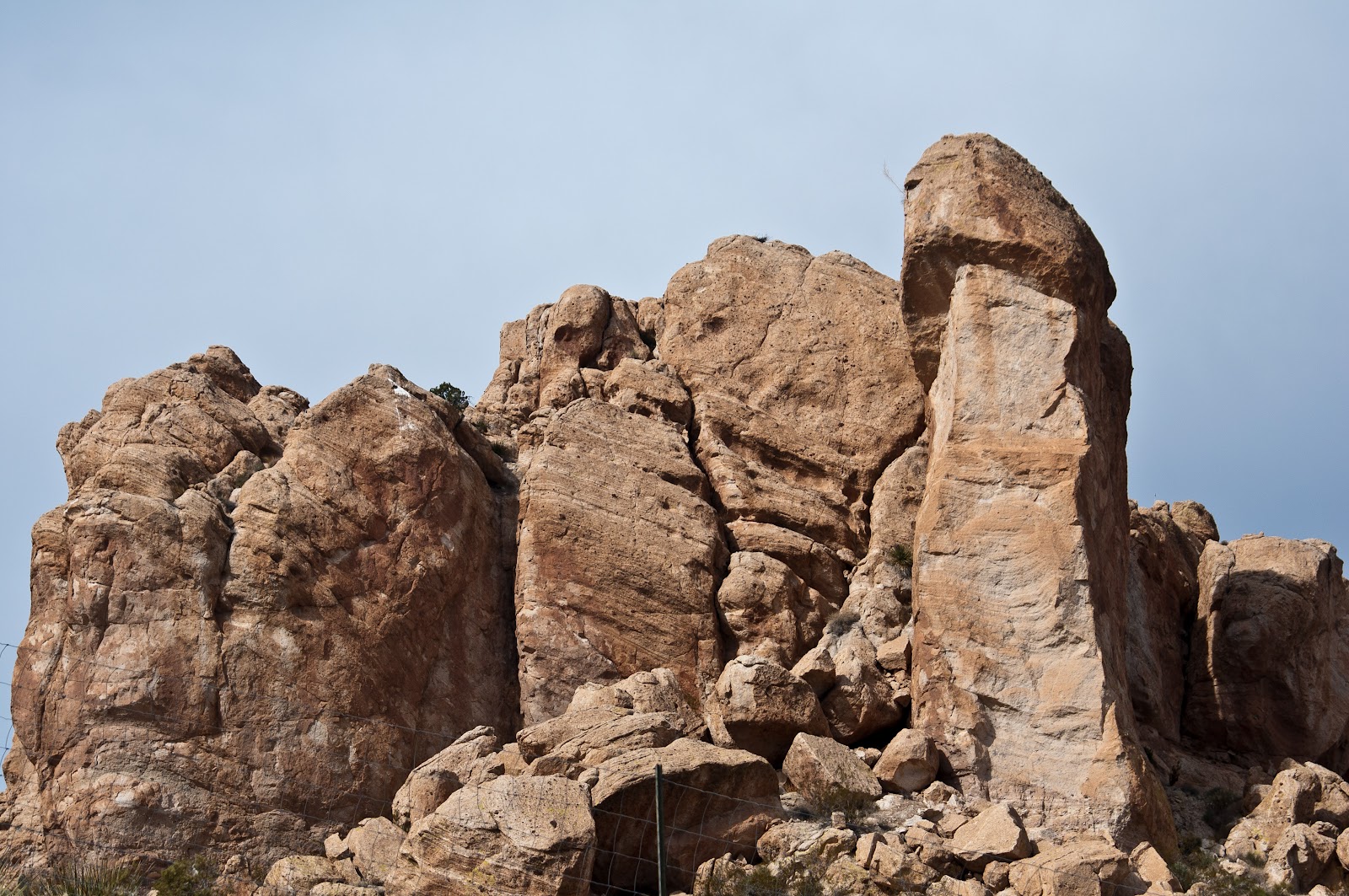
A first rock formation, first seen from quite a bit away, gives so-inclinedviewers the impression of the exposed middle finger. The flipped filthy finger flash becomes even more pointed at you as the road closes in on the rock formation.
As you get real close, you have an opportunity for a second impression. It does not take a PHD in Geology or abstract art, to see nature flipping you off as you drive buy. Yes, Mother Nature is calling you a Mother $%#&. The formation is called "Thumb Butte" on the Davis Dam 1:100,000 Quad Topographic Map of 1982.
"The Finger" of AZ68 Up Close
Thumb Butte from an entirely different angle with better lighting
***
A second rock formation right along the shoulder of the highway has an even more perverse appearance.
Even before I took the picture of this second formation, I certainly had a "naughty" subject in mind. When I posted the picture on Flickr, I gave the picture the intriguing, but tame (or lame?), title of "Interesting?" I did not give the picture any overtly suggestive or explicit title or id tags. I don't want my Fickr stream labelled anything other than safe.However, that did not stop someone else from taking a more explicit approach.
An "interesting" looking rock formation on AZ68
Not long (actually very shortly) after my version of the picture was posted to Flickr., someone outside my Flickr network saw the picture, tagged it "circumcision", and added it to her group "Circumcision." The someone goes under the name "I wasn't circumcised - Lucky being a girl."
I remember that day vividly and horrifically. It was my
saddest day ever in my 25 years as a park ranger.
I was
far into the rugged backcountry of the park (Anza-Borrego Desert
State Park). At Anza, I had packed and mounted my horse, Anzanita. We then continued southward about 10 miles on Coyote Canyon Road to the area known as Turkey Track. Turkey Track is ridiculously unstable (especially after rains), has sharp drop-offs, and ledges narrow and
covered by loose slate or mud after storms.Though the Track is open to true 4WD vehicles; I mean the type with high clearances, low gears, and wheel lock-outs, park guide books unanimously emphasize just how 'bad' this road is. Practically, the Track is really only accessible by horseback
riding, hiking, mountain biking, and burro trains.Between Upper Willows and Middle Willows, where I was when it happened, is closed to all vehicle travel. This three mile stretch is prime bighorn sheep watering areas.
The sounds of rocks sliding and falling does not take a park
ranger with 25years of experience to
identify.As I looked towards where
I heard the rock slide, what I saw broke my heart.I quickly grabbed my binoculars to double-check. I was right.Rolling down the rocky and wooded hill was one
of the park's bighorn rams. Also rolling down the hill, following the
ram, was a mountain lion.Through my binoculars, I saw another mountain lion cautiously
watching from the ledge as her mate and what I assumed to be their intended meal
rolled down the hill.
All this was happening on the other side of Coyote Canyon and it
would take me a while to get to a point where I could cross Coyote Creek
at a shallow, slow flowing part and then backtrack to the pointwhere the animals fell. I recorded my coordinates on the GPS and started walking, leading 'Zita by her reins.The animals on
the other side of the canyon would surely be DOA by the time I reached them- if
not dead already.
***
Back at Majanga Spring, way up on Majanga Flat, we all looked up from drinking.We heard the noise and the older among us knew
what it meant.I looked around.Old Biggy and Smitty were not with the herd. They were known to randomly go out and butt heads, though Smitty conceded Old Biggy's dominance within our herd.
I sent out a call and Smitty's long
yelp answered, but there was nothing returning from Old Biggy's drawling accent.We all thought we knew exactly what
happened.Slippage is a risk we face
every day as we move further and further uphill to protect ourselves against
those predators with the guts to follow us.We are typically the only ones that can make their way up so high on loose rocks and
into protection.But the higher we go,
the greater the risk.Indeed, when I was younger, I took a short slide down a steep canyon wall.
It is a risk we all
knowingly take because that is how we survive.
***
I had finally reached the 'drop zone', for
lack of better or more euphemistic term.I released a couple of shots from my Browning rifle into the air to
scare away any circling vultures, hiding coyotes, or surviving mountain lions to
clear the area for my safety.
The mountain lion's body was in much better shape than the ram's,
though the mountain lion was just as dead as the ram.The mountain lion just rolled down the hill, but the ram horns violently whipped
the ram's head around, got caught on branches, and bounced the poor ram's head off
rocks. What was left of the horns would not be going on display at any nearby
museums and the ram's neck was obviously broke.I guessed the ram died about 1/3 the way down and the mountain lion died on
impact with the ground.
I opened a saddle bag and took out a small laser bar-code
reader.Luckily for me, this ram did not lose its collar on the way down.I scanned the bar-code on the collar and a
code showed up on the display.The code meant
little to me out here in the field.The rangers
at Park HQ in Borrego Springs kept track of the animal database.
I walked around trying to find a clear area out from under the
tree canopy.I found a spot and called
park HQ on the sat phone.
"Hernandez, Animal Monitoring."
"Pico?Flack
here."
"Flack, you safe, mi
hermano?"
"Yes.I am at
the spot."
"You made good time."
"I guess brother..."
"Does he have an ear tag?"
"No. He barely even has an ear.Just a
collar."
"OK.Let me pull
up the database.Code?"
"C-O-0-1-7"
"An oldie.Hmm.'Old Biggy'...17 years
old... born in-park...Parented three rams and two ewes.Last vet check was about 6 months ago by Dr.
Floyd."
"He looks pretty bad; the severe horn damage from the fall,
some vulture feeding, and a broken neck.I'm guessing the mountain lions chased him and these two took a nasty, unintended
slide down a soft edge."
"OK.I will prepare
his file for closure when you get back.Don't forget to take blood samples and of course the tracking collar.Oh might as well take blood from both
animals.I will give you a break and not
ask for a fecal sample."
"Muchas gracias
on the fecal.I will mark the
coordinates of the site, post a marker, and take some pictures.No reason to bury or extricate the carcasses.I will leave them to the vultures; they have
already been munching away."
"Remember its the natural order of things."
"I know"
"Be safe, hermano."
"Gracias."
I stood there looking at the two carcasses and I gave them what
I thought was a proper blessing.
***
I slowly --carefully-- walked
towards the edge of the cliff where my father slipped and fell to his
death trying to escape from a mountain lion.I laid down and looked across the
valley.My nose suddenly picked up the
smell of a ewe.I turned around and it
was Santia, the alpha-ewe in our herd.She walked over to me and hit my snout with hers.That told me everything I needed to
know.
There are approximately 33 "road miles" between the inland Monterey County, CA, near ghost-town of Jolon and the Pacific Coast Highway (CA-1). Those 33 road miles twist and turn and cover a mere 20 "as the crow fly" miles.
The 33 road miles are in no way an easy drive. The switch-backs and alternating gas and brake pedalling will tire you...and then you will still have the strenuous drive north along the Big Sur coast to wherever you are going to call it a day. However, it is all worth it.
5) exiting Fort Hunter Liggett's back entrance, deep in the tree canopy of the Los Padres National Forest and beginning the trip over the Santa Lucia Range on Nacimiento-Fergguson Road, a road notorious for its driving challenges and views;
I remember my last trip through the area (2007) vividly. After exiting US101(historically known as El Camino Real) onto Metz Road in King City and then turning right onto Lonoak, there were hundreds of yellow onions scattered across the road. An overstuffed produce truck must have lost some of its load. Seeing fresh produce scattered about the roads is a common Salinas River valley sight. Once, on US101, we were passed by a flatbed trailer hauling loose carrots. The carrots were not boxed; rather, they were strapped down like lumber or pipes would. It was a mighty strange scene.
***
An aside... A major difference between central California and southern California are the smells. In SoCal, while at best, you may get a whiff of an orange grove here and there, aromas are pretty much left to fast food and smog. Oh, and in some places, when the wind is just right, the cow manure clouds flowing west from Chino are just a killer. On the other hand, the smells of central California depended on where you were and the crop rotation, but included, ripening strawberries, raspberries, grapes, lettuce, artichokes, garlic, onions, and ok, manure.
***
Just outside of King City, Lonoak Rd enters the curvy and bleak Bull Canyon area, which is used as grazing land, despite the apparent lack of grass.
Bull Canyon...
***
However, all it takes is one sweeping S-curve through Bull Canyon and you can then see a line of green across the horizon. Such greenery is typically indicative of a flowing river (also rare to SoCal, except after rains) and in a few minutes you are approaching San Lorenzo Creek. Just beyond the creek there is a gated entrance to a ranch where you can safely pull off the road and park to walk on the bridge and look down at the creek. Traffic is minimal and you can dance in the middle of the road, if that is your thing.
"From there we cross the river to our left, and traverse an undulated barren looking country for 20 miles, until we strike the San Lorenzo Creek, whose waters are clear, cold, and bitter". Anonymous traveler - as chronicled in History of Monterey County (1979 Reprint of 1881 Ed.).
Looking straight down from San Lorenzo Creek Bridge
Looking down the creek...
Birds circling the bridge...
After the bridge, a sign tells you that you have entered San Benito County. SBC was carved out of Monterey County in 1874 when the people of the area got fed up with being governed by folks on the other side of the Gabilan Range mountains. As you travel this last leg of Lonoak Road, the road curves and follows a wide bend in the creek. The area is called "Sulphur Springs" on the local USGS map.
Lonoak Rd encircling Sulphur Springs on USGS Topographic Map
Lonoak Rd encircling Sulphur Springs on Satellite Map
View of wide curve of San Lorenzo Creek at Sulphur Springs
As you come around the Sulphur Springs curve, you enter Lonoak, which is less of a town and more of a settlement of a few farms. There actually was a US Post Office in Lonoak from 1885-1954. This is no obvious sign of the old post office building as there is, for example, in the Kelso, CA ghostown.
Lonoak
Silos at Lonoak
Just before Lonoak Rd ends at CA25, strangely called Airline Highway on maps, you cross a bridge spanning the typically dry Lewis Creek and taking you back into Monterey County. This remote creek crossing is well known among back road travelers for opportunity to photo the junk cars that line the creek banks. The cars protect against erosion of the creek banks when water actually fills it.
by Steve Reiss (Dalmdad Landscape Photography - www.dalmdad.com and https://www.facebook.com/Dalmdad.) September 7, 2012: Near Yaqui Pass, Anza-Borrego Desert State Park, California I tend to go on-and-on about how Anza-Borrego Desert State Park is a great spot to see bighorn sheep. We hoped to see at least one on our way down Montezuma Grade, which as I have written before, is a prime bighorn observation point. Indeed, in February 2009, while going up the Grade, we saw a huge bighorn ram watching over the valley.
February 2009 Ram Sighting - "King of the Desert"
This time, going down the Grade, however, we wound up seeing zilch and mainly only saw the fire damage from the late August 2012 wildfires. At the base of the Grade, we drove through deserted Borrego Springs. This tourist spot was pretty dead and will have a totally different vibe come winter. No, it won't be filled with ski-bunnies and snow-boarders. But, with the winter temperature rarely exceeding the more tolerable 70F, the desert will be filled with hikers and off road vehicle drivers. Now, it is just still way too hot for anything. At Christmas Circle, we swung south out of town on our way to Julian. Yaqui Pass is another place to spot the bighorns. However, as the pass is quite tight with almost no places to pull over, photography is difficult. We did spot a ram and ewe in this general area back in November 2008.
November 2008 Ram and Ewe Sighting
Now, I was sitting in the back seat of the truck, with Joanie and her mom sitting upfront when Joanie let out an "I saw one" scream. Of course, by that time, we went through an S-curve that totally blocked our view of the bighorn. So, at the base of the hill, she stopped, I took out my camera and the biggie lens and got back in the truck. It was hot and dusty out and the "closed for the season" campground had a sign warning that the closest open bathroom was in Borrego Springs. We headed back up the hill, with no bighorns in sight. At the first turn-around, that is what we did, and we crawled down the highway, much to the chagrin of aggressive motorcyclists. We finally spotted the ram way up on a ledge. How Joanie sees these things is incredible. We pulled over the best we could and I snapped away. Even eyeballing the ram way up on the ledge, we could see it was with an ewe. Between the idling truck, my unsteady hands, and the difficulty of hand-holding a 600 mm lens, I was kind of down on the whole sighting and not expecting much from the pics. I raised the ISO of the camera to 1000, hoping for a sharper pic. As with the earlier ram sighting described above, these bighorns were in a terrible position for photographing; back lit. Post-processing the images to bring out the details made the colors somewhat unnatural, so I converted them to b&w.
September 2012 Ram and Ewe Sighting
September 2012 Ram and Ewe Sighting
September 2012 Ram and Ewe Sighting - View showing how close to the edge these guys can get!
September 2012 Ram and Ewe Sighting
***
Just as we pulled away to continue down the hill we were pulled over by a heavily armed, well armored cop of some type (there is a heavy Border Patrol at certain parts of the park). He reminded us that pulling over in this area was very dangerous (yeah), but let us go without a ticket.
Next stop was Julian and some ice cream.
For those keeping track or out looking for the bighorns on their own, here is a summary of our sighting locations and good places to start your search.
July 9, 2011/August 11, 2012: Colton, CA: The Agua Mansa Pioneer Cemetery (AMPC) (Find A Grave) is well hidden by a solid gate and a row of closely aligned trees lining Agua Mansa Road in Colton, CA, between San Bernardino and Riverside. If you are not careful, you will probably pass it. I actually passed it twice (back and forth).
The Cemetery is all that is left of Agua Mansa (considered a ghost town) and it is a desolate, dry location, partially surrounded by quarries and/or landfills. Agua Mansa and La Placita were on opposite sides of the Santa Ana River, and, in the 1840's, formed the largest settlement between Los Angeles and New Mexico. Both settlements were washed away by the Great Flood of 1862.
Desolate Location
The top of this tree is very strange (quarry or landfill in background).
It was triple-digit hot when I was there in August, 2012, and despite a grass sprinkler here and there, there is very little grass and very much loosely packed dry dirt with burrow holes.
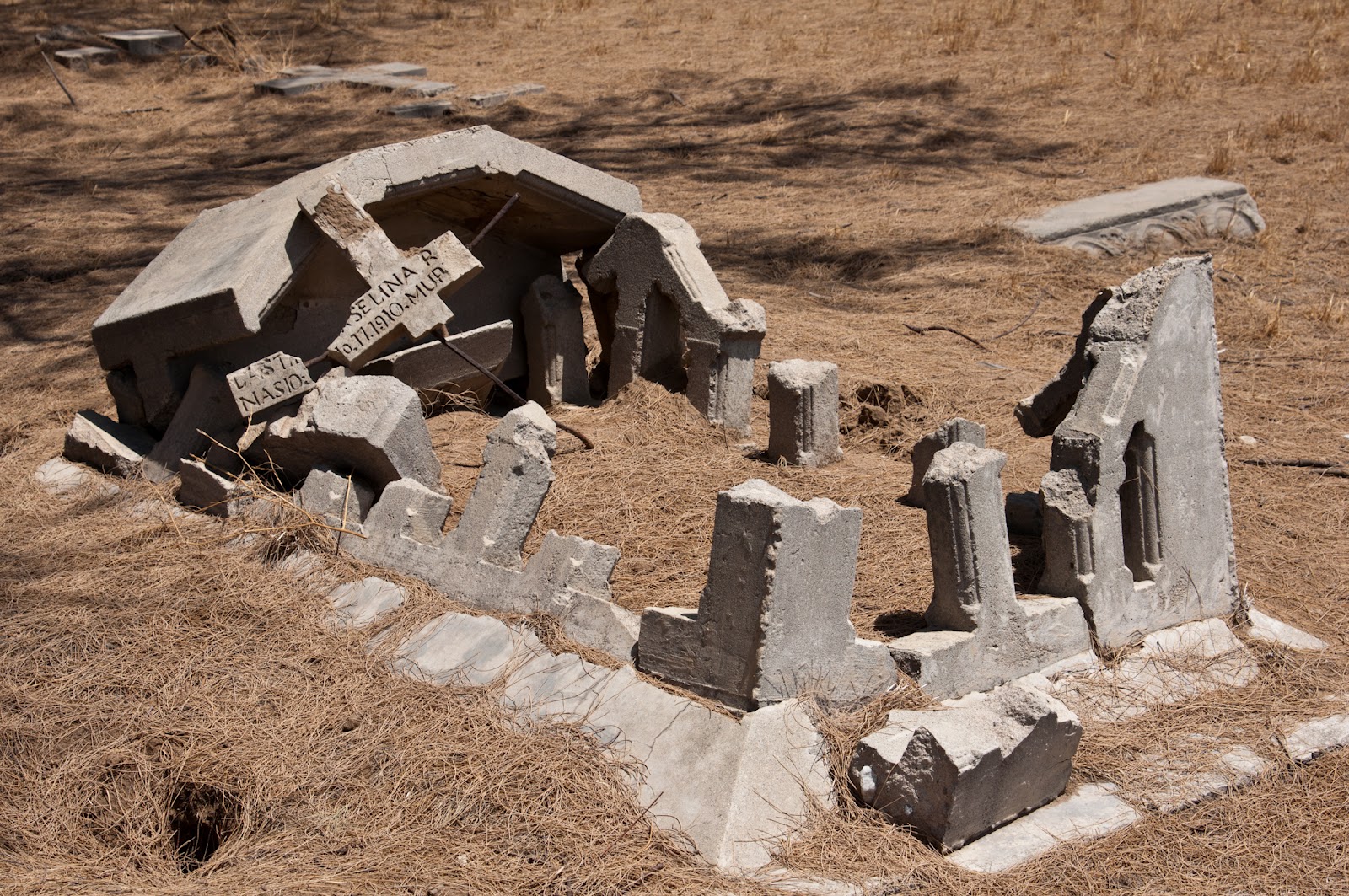
Most of the grave markers are very old and some damaged to a point preventing the ability to read the name or date of death of the buried.
Heavily Damaged Grave Sites
***
Some grave markers are surrounded by small gates.
The gate cross in detail
Every once in a while, a clearly readable marker is found. While some of these have such early death-dates, I wonder whether they are replacement markers.
Readable Markers
***
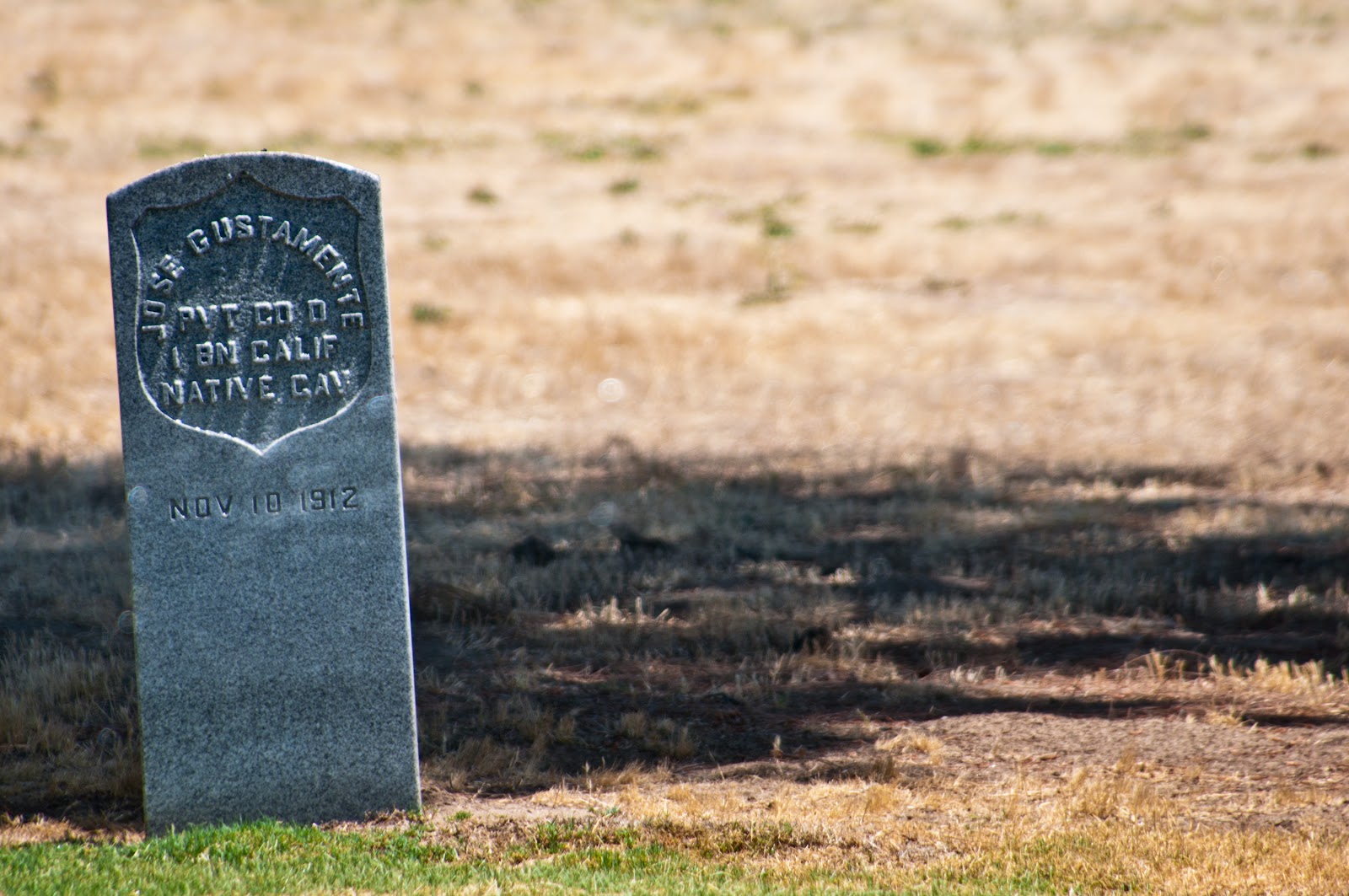
Aside from all the civilian graves, there is a single military one. While in no way is this burial site as scenic or pleasant to visit than Fort Rosecrans National Cemetery, which I wrote about earlier, the lone soldier gets the honor of being the only person in this cemetery buried in the shade under a huge tree and with some nearby grass. The grave is for Jose Gustamante, who died in 1912.
The marker says Mr. Gustamonte was a member of Company D, 1st California Native Cavalry. Company D spent most of the US Civil War keeping the peace in LA County, where seccessionist sympathy was high, and later parts of the Civil War in Arizona Terriotry, which the Confederacy sought to annex. These are details of the Civil War which we are not taught about back east.
***
The Cemetery Chapel is an annex to a private residence