Showing posts with label desert tortoise. Show all posts

Wednesday, February 26, 2014

Pleased to be Published In a New Book About Death Valley

by Steve Reiss (Dalmdad Landscape Photography - www.dalmdad.com and https://www.facebook.com/Dalmdad.)

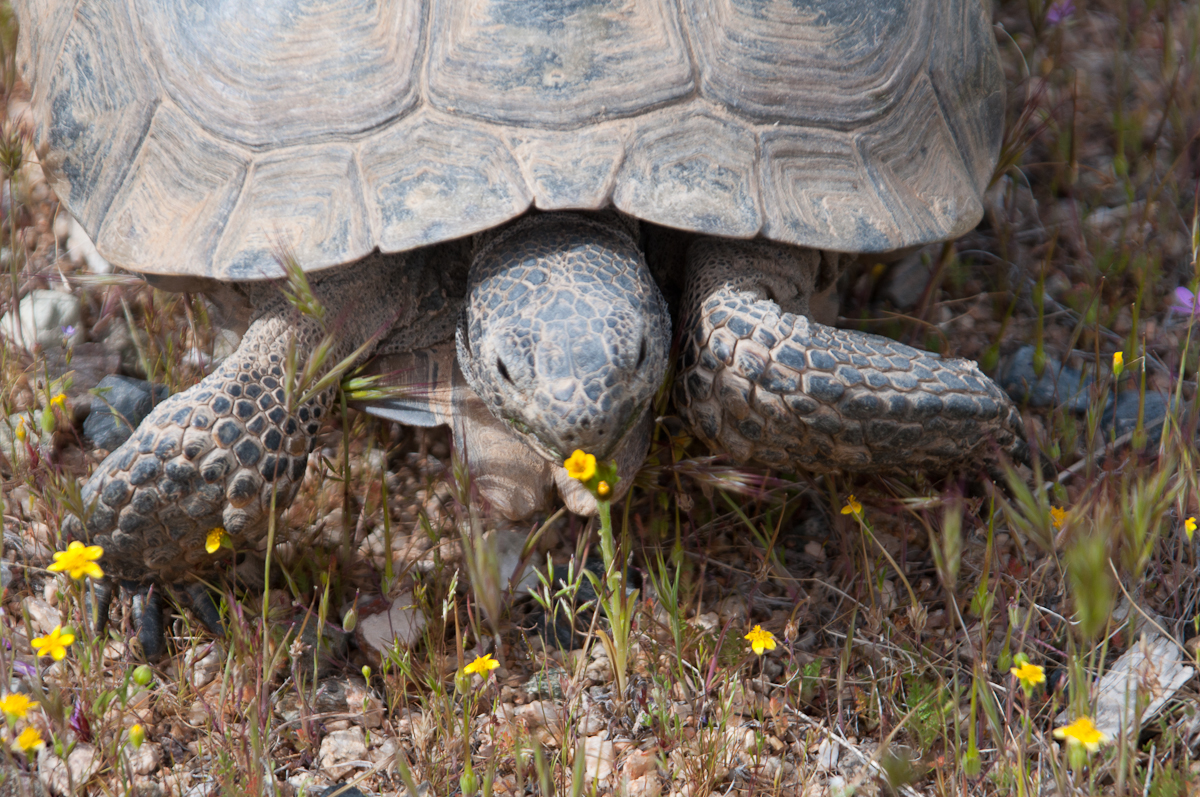
We are pleased to belatedly announce that we were actually paid to have one of our desert tortoise pictures to be included in Death Valley: Hottest Place on Earth, by Roger Naylor.  We have looked over the book and are pleased to be associated with it and endorse it to our readers and followers.  The book is in large format softcover, heavy gloss paper, and full color.  The images range from small pictures like ours, to full page dramatic and panoramic shots.  The text subjects are interesting and well organized.

The book is available from the link above at Rio Nuevo Publishers out of Tuscon, for $12.95.


Our photo is down in the lower left corner of p. 71.


 And our credit....

 ***
Note: Our desert tortoise picture was not taken at Death Valley.  Rather, the picture was taken at the Desert Tortoise Natural Area, outside California City, CA, in the western Mojave Desert.  Click here for more of our pictures from the DTNA.

Monday, November 11, 2013

Meeting the Same Desert Tortoise Twice! (Reprint)

by Steve Reiss (Dalmdad Landscape Photography - www.dalmdad.com and https://www.facebook.com/Dalmdad.) 

This article was originally published at DesertUSA, on September 14, 2013.

***

What is the probability that you will ever meet the same desert tortoise twice?  I guess the probability is pretty good if you happen to be visiting with the desert tortoises of the Desert Tortoise Natural Area (DTNA) in California City, CA. 
Entrance to the DTNA off of Randsburg-Mojave Road
It was in April 2011, in the parking lot of the DTNA, that purely by accident, I had the pleasure of meeting the female desert tortoise that goes by the name Starfoot.   A docent pointed her out.  I would have drove right passed Starfoot if she was not pointed out to me.  Watching and hearing Starfoot scrape her uniquely deformed claws against the parking lot floor as she walked around, was intriguing.
Starfoot Frolicking in the Wildflowers in 2011


20110402-DSC_0094
Starfoot's Characteristic Foot

Starfoot Munching on Wildflowers in 2011

***
Two years later, in May 2013, I took a ride out to the DTNA in combination with a very successful desert bighorn sheep search out at Zzyzx. As usual, I spent the previous night in Mojave, CA.  This way, I was able to arrive at the DTNA around 8AM.  You want to arrive early because the tortoises go back to their dark and cool underground burrows as the desert temperature skyrockets throughout the day.

Shortly after arriving at the DTNA, I spotted Tortoise 1056; near the information kiosk.  I took about 100 pictures, checked my water supply, and started to walk through the dry, dusty, and pretty miserable grounds of the DTNA.  This is not an insult to the upkeep of the DTNA, but an acknowledgment that the DTNA is out in the middle of the harsh and inhospitable western Mojave Desert.
Tortoise 1056 in 2013
I did not see any other tortoises while walking the nature path and I could barely move my camera fast enough to catch the lizards darting from creosote bush to creosote bush; trying to minimize their time in the sun.  At first, I listened to music while I roamed around, but ear buds and music muffle the sounds of the small animals running around, making it even that much harder to photograph desert creatures running from the blazing sun to the shade of bushes.

Darting Lizard
Darting Lizard
When I made it back to the shade of the information kiosk, suddenly a slight breeze combined with the shade made the weather almost tolerable.  The docent pointed out there was another tortoise searching for food.  When I spotted it, low and behold, there were the crazy feet of Starfoot.
Starfoot's Starfoot (2013)


Starfoot Searching For Anything to Eat or Drink (2013)


Starfoot in 2013
Starfoot in 2013 (note twin gular scutes under head)
 Despite my having met Starfoot before, two years earlier, Starfoot was not very open to conversation.  I may have been deemed a people person by some wacky industrial psychiatrist in Grand Rapids, MI once, but Dr. Doolittle I am not.
No Luck Talking With this Fox in Alaska
No Luck Talking With this Fox in Denali National Park, Alaska (2001)
 ***

There are several interesting things to notice between these sets of pictures taken at the DTNA almost exactly two years apart.

First, there was much more plant and wildflower matter at the DTNA in 2011.  The 2013 docent told me rain had been very scarce the previous winter and so the entire reserve was well dried out.  While in 2013, we see Starfoot nibbling at the sand, in search of anything to eat and any drops of water; in 2011, she had plenty of greenery to chew.
Wildflowers at DTNA in 2011


Desolate Grounds of DTNA in 2013

Second, Starfoot's shell has apparently taken a beating in the rough conditions of the DTNA.  In the 2011 photos, what looks like the number 59 or 55 can be seen as carved/scratched in the second costal scute (individual shell plate) on the right side (in the picture) of Starfoot's carapace (shell dome). 

Starfoot's Shell Number (2011)
That portion of the shell seem to have been damaged.  Weathering on the dome plates is obvious in the later pics.
Starfoot's Shell Number (2013)
***
I hope to see Starfoot again in spring of 2014.


Saturday, October 27, 2012

Over the Mountains and Through the Woods, to the Pacific Ocean we go...

 by Steve Reiss (Dalmdad Landscape Photography - www.dalmdad.com and https://www.facebook.com/Dalmdad.)

There are approximately 33 "road miles" between the inland Monterey County, CA, near ghost-town of Jolon and the Pacific Coast Highway (CA-1).  Those 33 road miles twist and turn and cover a mere 20 "as the crow fly" miles.

The 33 road miles are in no way an easy drive.  The switch-backs and alternating gas and brake pedalling will tire you...and then you will still have the strenuous drive north along the Big Sur coast to wherever you are going to call it a day.  However, it is all worth it.

Included in the 33 miles are:

1) visiting the remnants of Jolon, once a thriving community.  Now, not so much;

2) visiting Fort Hunter Ligget, known for the herd of free-range tule elk that roam the fort grounds;

3) visiting Mission San Antonio and its parish desert tortoise, also on the fort grounds;

4) driving through the fort's live fire practice range;

5) exiting Fort Hunter Liggett's back entrance, deep in the tree canopy of the Los Padres National Forest and beginning the trip over the Santa Lucia Range on Nacimiento-Fergguson Road, a road notorious for its driving challenges and views;

6) driving along the peak ridge of the Santa Lucia Mountains;

7) overlooking the Pacific Ocean and the cloud cover before coming down and merging with the Pacific Coast Highway.

This is pretty much an all day trip, but as I mentioned, well worth the time.

Over the next 7 weeks, we will be describing for you each of these segments.  We hope you enjoy and can take the drive some time.

The Drive Profile