Showing posts with label mojave desert. Show all posts

Monday, November 11, 2013

Meeting the Same Desert Tortoise Twice! (Reprint)

by Steve Reiss (Dalmdad Landscape Photography - www.dalmdad.com and https://www.facebook.com/Dalmdad.) 

This article was originally published at DesertUSA, on September 14, 2013.

***

What is the probability that you will ever meet the same desert tortoise twice?  I guess the probability is pretty good if you happen to be visiting with the desert tortoises of the Desert Tortoise Natural Area (DTNA) in California City, CA. 
Entrance to the DTNA off of Randsburg-Mojave Road
It was in April 2011, in the parking lot of the DTNA, that purely by accident, I had the pleasure of meeting the female desert tortoise that goes by the name Starfoot.   A docent pointed her out.  I would have drove right passed Starfoot if she was not pointed out to me.  Watching and hearing Starfoot scrape her uniquely deformed claws against the parking lot floor as she walked around, was intriguing.
Starfoot Frolicking in the Wildflowers in 2011


20110402-DSC_0094
Starfoot's Characteristic Foot

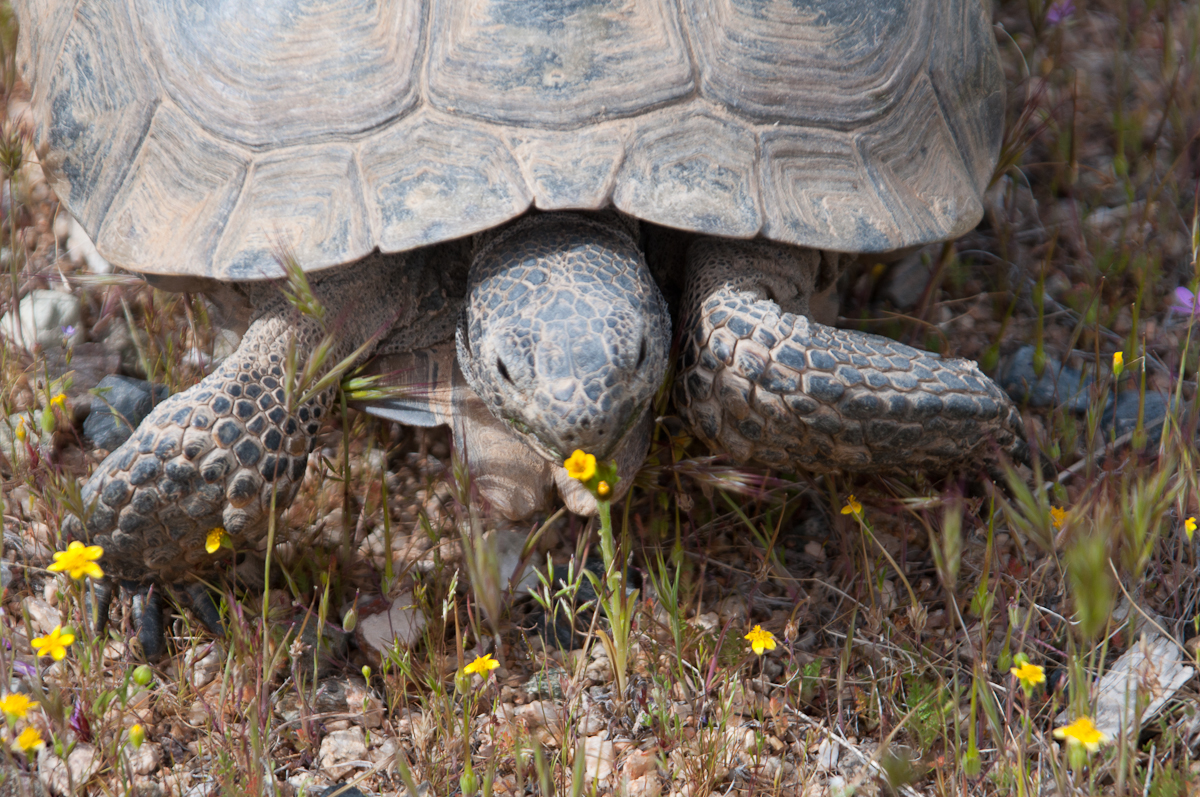
Starfoot Munching on Wildflowers in 2011

***
Two years later, in May 2013, I took a ride out to the DTNA in combination with a very successful desert bighorn sheep search out at Zzyzx. As usual, I spent the previous night in Mojave, CA.  This way, I was able to arrive at the DTNA around 8AM.  You want to arrive early because the tortoises go back to their dark and cool underground burrows as the desert temperature skyrockets throughout the day.

Shortly after arriving at the DTNA, I spotted Tortoise 1056; near the information kiosk.  I took about 100 pictures, checked my water supply, and started to walk through the dry, dusty, and pretty miserable grounds of the DTNA.  This is not an insult to the upkeep of the DTNA, but an acknowledgment that the DTNA is out in the middle of the harsh and inhospitable western Mojave Desert.
Tortoise 1056 in 2013
I did not see any other tortoises while walking the nature path and I could barely move my camera fast enough to catch the lizards darting from creosote bush to creosote bush; trying to minimize their time in the sun.  At first, I listened to music while I roamed around, but ear buds and music muffle the sounds of the small animals running around, making it even that much harder to photograph desert creatures running from the blazing sun to the shade of bushes.

Darting Lizard
Darting Lizard
When I made it back to the shade of the information kiosk, suddenly a slight breeze combined with the shade made the weather almost tolerable.  The docent pointed out there was another tortoise searching for food.  When I spotted it, low and behold, there were the crazy feet of Starfoot.
Starfoot's Starfoot (2013)


Starfoot Searching For Anything to Eat or Drink (2013)


Starfoot in 2013
Starfoot in 2013 (note twin gular scutes under head)
 Despite my having met Starfoot before, two years earlier, Starfoot was not very open to conversation.  I may have been deemed a people person by some wacky industrial psychiatrist in Grand Rapids, MI once, but Dr. Doolittle I am not.
No Luck Talking With this Fox in Alaska
No Luck Talking With this Fox in Denali National Park, Alaska (2001)
 ***

There are several interesting things to notice between these sets of pictures taken at the DTNA almost exactly two years apart.

First, there was much more plant and wildflower matter at the DTNA in 2011.  The 2013 docent told me rain had been very scarce the previous winter and so the entire reserve was well dried out.  While in 2013, we see Starfoot nibbling at the sand, in search of anything to eat and any drops of water; in 2011, she had plenty of greenery to chew.
Wildflowers at DTNA in 2011


Desolate Grounds of DTNA in 2013

Second, Starfoot's shell has apparently taken a beating in the rough conditions of the DTNA.  In the 2011 photos, what looks like the number 59 or 55 can be seen as carved/scratched in the second costal scute (individual shell plate) on the right side (in the picture) of Starfoot's carapace (shell dome). 

Starfoot's Shell Number (2011)
That portion of the shell seem to have been damaged.  Weathering on the dome plates is obvious in the later pics.
Starfoot's Shell Number (2013)
***
I hope to see Starfoot again in spring of 2014.


Wednesday, March 13, 2013

Do You Zzyzx?? Do You Want to Zzyzx?

by Steve Reiss (Dalmdad Landscape Photography - www.dalmdad.com and https://www.facebook.com/Dalmdad.)


I am working on a self-funded project about what I call the "Zzyzx Phenomena" (i.e., all things Zzyzx).
 
I am looking for fellow desert explorers interested in contributing to this project.
 
Contributions would be short essays describing what Zzyzx means to you, how you developed an interest in Zzyzx, or any other Zzyzx anecdotes.  Also, interesting photos taken in the Zzyzx area are also welcome.  Please also tell me your city and state.  Let's see from how far away Zzyzx is known.
 
Note that any submissions shall be considered to include your approval of my printing or publishing your submission, in whole or part, with (i.e., name, city/state) or without (i.e., "anonymous") attribution, without compensation, and in any form.  If you want to limit your submission to "anonymous" attribution, please let me know.
 
Contributions should be sent to zzyzx@dalmdad.com.
 
See you roaming the desert,
Steve Reiss

Wednesday, February 27, 2013

Cholla Cactus and The Cholla Cactus Garden at Joshua Tree NP

by Steve Reiss (Dalmdad Landscape Photography - www.dalmdad.com and https://www.facebook.com/Dalmdad.)

The cholla cactus garden at Joshua Tree National Park is located right next to the Octotillo Flats area, in the low desert portion of the park.  For those unfamiliar with JTNP, the park basically has two very different ecosystems; namely, the low Colorado Desert portion (below 3000 ft) and the high Mojave Desert portion (above 3000 ft). 

The low Colorado desert portion is warmer than the high desert portion, more barren, and populated by cholla cactus and ocotillo.  The cholla cactus and the ocotillo are two of the four characteristic desert plants of the the Southwest USA and northern Mexico.  The other two characteristic plants are both in the yucca family and more widely found in the high Mojave Desert portion.  In particular, they are the Joshua Tree (Yucca brevifolia) and the Banana Yucca (Yucca Baccata).

JTNP's cholla cactus garden is a dense, localized (just a few square miles), forest of teddy-bear (Cylindropuntia bigelovii) cholla cactus.  Only a small portion of the small forest is open to visiting.  The hiking trail is a short and flat 1/4 mile. 

The teddy-bear moniker is based on the fact that from a distance, and especially when back-lit (see this discription describing best times of day for picture taking), the plants appear soft and fuzzy, giving it the name "teddy bear".


Cholla cacti produce few seeds.  The plant usually reproduces from dropped stems. These stems are often carried for some distance by sticking to the hair of animals. Often small "forests" of these chollas form that are largely clones of one individual/original cholla plant. This "cloning" of a single plant in a narrow area is why cholla forests are often densely packed.

Dense Cholla Forest
When a piece of cholla sticks to an unsuspecting person, a good method to remove the cactus is with a hair comb (video on how to remove teddy bear cholla spines).  The spines are barbed, and hold on tightly.  Some people seem to find it amusing to post videos of themselves being barbed by the chollas: (ouch #1), (ouch #2).

After one of my earliest visits to a cholla forest in the Mojave National Preserve/Cima Dome area, I had got a bunch of cholla barbs in my calfs.  I had some kind of allergic reaction to the cholla and had to go on some steriods; the itching drive me nuts.


The teddy-bear cholla is extremely combustible.  This is shown in the following series of pictures.


The nickname "The Jumping Cactus" was given to the Teddy Bear Cholla as people swore as they passed by one, the plant jumped out at them, leaving several painful spines stuck in their knee or other body part. In fact, the Teddy Bear Cholla does not move on its own

Here's what happens:

The tiny spines on the Teddy Bear Cholla are very easily removed from the plant, so if you even lightly brush up against it, you will have many tiny spines stuck in your knee or what ever body part touched the plant. In fact, horse-riding cowboys began wearing thick leather chaps to protect their legs primarily from the Teddy Bear Cholla. 

So, don't let anyone scare you into thinking there are plants in the Sonoran Desert that will "attack" you. The only way you can be injured by the Teddy Bear Cholla is to touch it.