Showing posts with label mojave national preserve. Show all posts

Saturday, October 19, 2013

Watching Over the Bighorn Sheep Herd at Zzyzx (Part V of Tales of the Bighorns)

by Steve Reiss (Dalmdad Landscape Photography - www.dalmdad.com and https://www.facebook.com/Dalmdad.)

May 11, 2013

So, lets end this whole Bigsheep watching trip with some views of the bosses.  Here are some of the bighorns standing up on the rocks, in the sun, watching down on the action...


All photos available for purchase or license by special order.  Contact steve@dalmdad.com.

Wednesday, October 16, 2013

Close-ups of Bighorn Sheep at Zzyzx (Part IV of Tales of the Zzyzx Bighorns)

by Steve Reiss (Dalmdad Landscape Photography - www.dalmdad.com and https://www.facebook.com/Dalmdad.)

May 11, 2013

How about some close-ups of seriously staring bighorn sheep at Zzyzx...

I smell SOMETHING!


You call'in me?

I need a break from this photographer guy.

I have such great posture!

So my bite is not exactly straight.

This guy with the camera just will not go away.

 Left- What ya think?  Right- No clue!

Ho Hum.


So, I can use a shave, they tell me.
There is one more post in this series coming up...Ewes and rams looking down on the herd!

All photos available for purchase or license by special order.  Contact steve@dalmdad.com.

Sunday, October 13, 2013

Prancing Bighorn Sheep at Zzyzx (Part III of Tales of the Zzyzx Bighorns)

by Steve Reiss (Dalmdad Landscape Photography - www.dalmdad.com and https://www.facebook.com/Dalmdad.)

May 11, 2013...

In our last two posts (lamb slideshow/lamb pictures) of the Zyzzx Bighorns, we focused on the 2 week old lamb that was doing its best to find some shade from the afternoon sun.

This post will focus on the prancing ewes and rams at ground level. 

Bighorn Prancing Across Soda Dry Lake

Bighorn Prancing Across Soda Dry Lake

Bighorns Prancing Across Soda Dry Lake

Bighorns Prancing Across Zzyzx Road

Bighorns Prancing Across Zzyzx Road

Bighorn Prancing Through Salt Marsh
Bighorn Making its Way Down the Rocks

Bighorn Trying to not Slide Down the Rocks

The next post in this series will focus on closeups of the ewes and rams.

The last post in this series will focus on the ewes and rams up on the rocks watching the rest of the herd.

All photos available for purchase or license by special order.  Contact steve@dalmdad.com.

Tuesday, September 24, 2013

Bighorn Sheep Herd at Zzyzx (Part II of Tales of the Zzyzx Bighorns)(w/Lamb Pics)

by Steve Reiss (Dalmdad Landscape Photography - www.dalmdad.com and https://www.facebook.com/Dalmdad.)

The two lamb videos/slideshows in my earlier post about seeing the bighorn sheep herd at Zzyzx in May, 2013 did not come out all that well.

Seeing a 2-week old bighorn lamb within 100 feet or so, is pretty rare (although here is a ewe and 2 lambs from another sighting) and absolutely spectacular.  This lamb deserved a more significant posting of its cuteness.

***

Bighorn ewes have a six-month gestation. In temperate climates, the peak of the rut occurs in November with one, or rarely two, lambs being born in May. Most births occur in the first two weeks of the lambing period. 

Lambs born earlier in the season are more likely to survive than lambs born later. Lambs born late may not have access to sufficient milk, as their mothers are lactating at a time when food quality is lower. Newborn lambs weigh from 8 to 10 lb and can walk within hours. The lambs are then weaned when they reach four to six months old. 


 ***

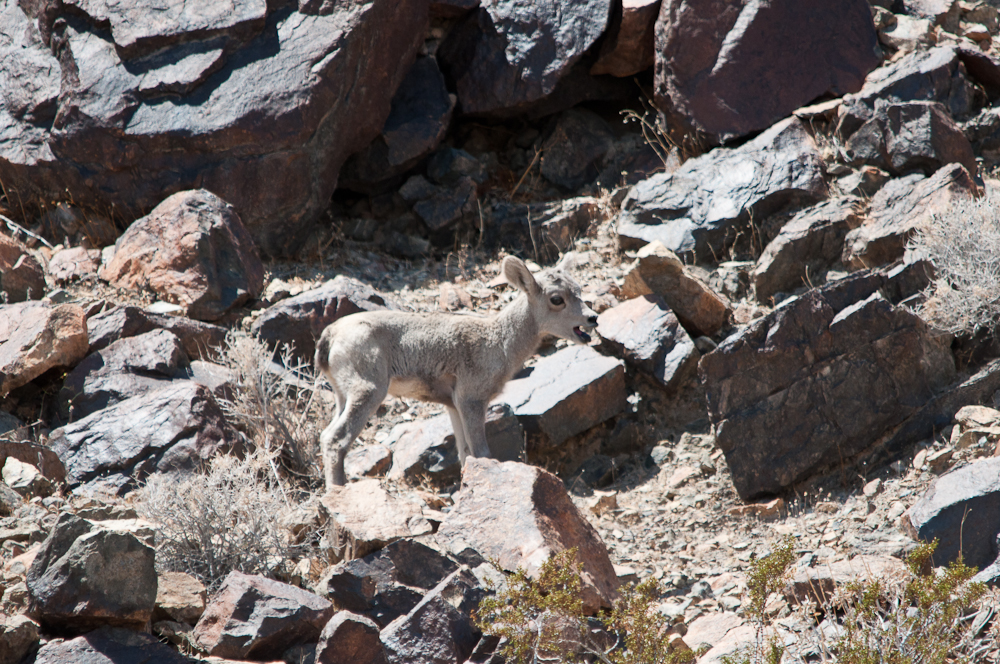
For your enjoyment, I present the raw images of a 2-week old lamb exploring his new world and searching for shade.

Eventhough I am pretty young, I can gallop over these loose and jagged rocks!

Looking for shade

I think I found shade

Hmm.  Can I fit in here?

Lookin' Good!

Great shade!!

I am really liking this spot!!

Hey Dad...Look at this great spot I found!

Time to head home

Eventually I will learn to breath with my mouth shut!

                                                                              ***
Part III of this post cycle/string (coming soon) will contain pics of the grown bighorns of this lamb's herd.

Note: All our bighorn sheep photos are available for licensing on very reasonable terms.

Saturday, August 24, 2013

Bighorn Sheep Herd at Zzyzx (Part I of Tales of the Zzyzx Bighorns) (Lamb w/video)

by Steve Reiss (Dalmdad Landscape Photography - www.dalmdad.com and https://www.facebook.com/Dalmdad.)

It was April, 2011 when I first saw the bighorn sheep crossing sign on Zzyzx Road, just outside the Desert Studies Center.  However, in all my times exploring this area, I never actually saw any bighorns.  That does not mean there may not have been any bighorns hiding up in the rocky hills, invisible to my poor eyesight.

Looking north on Zzyzx Road (Hill to the left/Soda Dry Lake to the Right)
 In September 2011 I had my then-closest bighorn experience at Willow Beach, just below Hoover Dam in the Black Hills of northwest Arizona.  Having bighorns so close made for an incredibly exciting day.  I did not get this close to wild bighorn sheep again for a while, having to settle for seeing bighorns only at long distances at Anza-Borrego. 

In early 2013, while recently doing some research on Zzyzx for other purposes, I was lucky enough to be placed into contact with someone very knowledgeable about the Desert Studies Center and Zzyzx area.  On May 8, I asked him about the bighorn sign; asking him when was it actually possible to see any.

I almost hyperventilated at my desk when I read his e-mail saying: 

        "see them daily now along zzyzx road.  Groups of 25-35 on a regular basis..." 


25-35 on a regular basis?  Wow!

So, off to Zzyzx I went that very weekend.

When I got there, I almost super-hyperventilated (if there is such a thing) when I saw the herds of bighorns roaming around at road level, standing on the rocky hills, and hanging out in a marsh.  A feast for lovers of the bighorn.

Now, if this was not exciting enough, perfection followed.  A lamb, maybe 2 weeks old, was making its way across the loose rocks of the hillside.  It was followed by a ewe and tucked itself into a tiny cave in the hill.


More on the herd to follow...

Wednesday, February 27, 2013

Cholla Cactus and The Cholla Cactus Garden at Joshua Tree NP

by Steve Reiss (Dalmdad Landscape Photography - www.dalmdad.com and https://www.facebook.com/Dalmdad.)

The cholla cactus garden at Joshua Tree National Park is located right next to the Octotillo Flats area, in the low desert portion of the park.  For those unfamiliar with JTNP, the park basically has two very different ecosystems; namely, the low Colorado Desert portion (below 3000 ft) and the high Mojave Desert portion (above 3000 ft). 

The low Colorado desert portion is warmer than the high desert portion, more barren, and populated by cholla cactus and ocotillo.  The cholla cactus and the ocotillo are two of the four characteristic desert plants of the the Southwest USA and northern Mexico.  The other two characteristic plants are both in the yucca family and more widely found in the high Mojave Desert portion.  In particular, they are the Joshua Tree (Yucca brevifolia) and the Banana Yucca (Yucca Baccata).

JTNP's cholla cactus garden is a dense, localized (just a few square miles), forest of teddy-bear (Cylindropuntia bigelovii) cholla cactus.  Only a small portion of the small forest is open to visiting.  The hiking trail is a short and flat 1/4 mile. 

The teddy-bear moniker is based on the fact that from a distance, and especially when back-lit (see this discription describing best times of day for picture taking), the plants appear soft and fuzzy, giving it the name "teddy bear".


Cholla cacti produce few seeds.  The plant usually reproduces from dropped stems. These stems are often carried for some distance by sticking to the hair of animals. Often small "forests" of these chollas form that are largely clones of one individual/original cholla plant. This "cloning" of a single plant in a narrow area is why cholla forests are often densely packed.

Dense Cholla Forest
When a piece of cholla sticks to an unsuspecting person, a good method to remove the cactus is with a hair comb (video on how to remove teddy bear cholla spines).  The spines are barbed, and hold on tightly.  Some people seem to find it amusing to post videos of themselves being barbed by the chollas: (ouch #1), (ouch #2).

After one of my earliest visits to a cholla forest in the Mojave National Preserve/Cima Dome area, I had got a bunch of cholla barbs in my calfs.  I had some kind of allergic reaction to the cholla and had to go on some steriods; the itching drive me nuts.


The teddy-bear cholla is extremely combustible.  This is shown in the following series of pictures.


The nickname "The Jumping Cactus" was given to the Teddy Bear Cholla as people swore as they passed by one, the plant jumped out at them, leaving several painful spines stuck in their knee or other body part. In fact, the Teddy Bear Cholla does not move on its own. 

Here's what happens:

The tiny spines on the Teddy Bear Cholla are very easily removed from the plant, so if you even lightly brush up against it, you will have many tiny spines stuck in your knee or what ever body part touched the plant. In fact, horse-riding cowboys began wearing thick leather chaps to protect their legs primarily from the Teddy Bear Cholla. 

So, don't let anyone scare you into thinking there are plants in the Sonoran Desert that will "attack" you. The only way you can be injured by the Teddy Bear Cholla is to touch it.