Tuesday, November 26, 2013

Overcoming The Trifecta for Photographic Failure

by Steve Reiss (Dalmdad Landscape Photography - www.dalmdad.com and https://www.facebook.com/Dalmdad.)


Bland and Mediocre - Help is on its way!
"Chinese music under banyan trees. Here at the dude ranch above the sea."
From: "Aja" (1977), song and album, by Steely Dan.
***
What do you do with you with the thousands of pictures you may take on your vacation that just don't make the cut?  Even in a photographic paradise like Hawaii, you can find your camera facing the wrong angle, under the wrong light, and subjected to less than adequate weather.  This trifecta for photographic failure occurred often on our recent trip to the Big Island of Hawaii.  

On June 12, 2013, at Hilo, HI, the weather was an annoying conglomeration of light and dark overcast and stopping and starting rain drizzles.  Nothing disastrous, but the climate conditions would be enough to annoy the average photographer and destroy the morale of this photographer.

I took over 2100 photos on our Hawaii trip; many under less than favorable photographic conditions.  It does not take long to identify and decide what to do with the better shots.  So, what do you do with a couple of dozen pictures taken under such mediocre conditions?  

At first, I tended to just mope about it, mumbling such inane comments as "This is why I came to Hawaii?...All these miles?" 

***

I tend to let mediocre pictures sit for about 4 months before looking at them again (I rarely delete pictures no matter how bad they are (see example)).  The stewing time is not some strange length of time that I sit around hoping that the picture quality will somehow magically improve.  Rather, the period of time you let the photos sit, the hope is that when you look at the photos afresh, you might have some ideas on how can they be salvaged.  Photos do not magically improve in quality; they merely become salvageable due to ideas on how to play with them using Photoshop and Lightroom.  This is exactly what happened here.

***

These banyan trees shown above picture are in Bayfront Park, on the Hilo shore, and suffer from poor lighting and an annoying yellow gate.  Because the trees blocked most of the light, the camera over exposed the picture, resulting in the very few portions of the sky passing between the branches being pretty washed out.  Sure, this scene could have been salvaged at the site by bracketing and HDR merger techniques.  I normally do not use them however.
***
In this first treatment, the entire image is converted to black and white, a strong fill light effect applied, and details brought out to show the texture in the trees.  Of the three treatments, this one is my favorite.


Banyan I
***

In this second treatment,the colors are slightly desaturated

Banyan II

 ***
In this third treatment, recovery is maximum, fill light is maximum, details enhanced very high; colors very strong.


Banyan III
***


If you would like to purchase any of these. click through on the desired picture to go to its offering on Banyans at Dalmdad.Com.


Monday, November 11, 2013

Meeting the Same Desert Tortoise Twice! (Reprint)

by Steve Reiss (Dalmdad Landscape Photography - www.dalmdad.com and https://www.facebook.com/Dalmdad.) 

This article was originally published at DesertUSA, on September 14, 2013.

***

What is the probability that you will ever meet the same desert tortoise twice?  I guess the probability is pretty good if you happen to be visiting with the desert tortoises of the Desert Tortoise Natural Area (DTNA) in California City, CA. 
Entrance to the DTNA off of Randsburg-Mojave Road
It was in April 2011, in the parking lot of the DTNA, that purely by accident, I had the pleasure of meeting the female desert tortoise that goes by the name Starfoot.   A docent pointed her out.  I would have drove right passed Starfoot if she was not pointed out to me.  Watching and hearing Starfoot scrape her uniquely deformed claws against the parking lot floor as she walked around, was intriguing.
Starfoot Frolicking in the Wildflowers in 2011


20110402-DSC_0094
Starfoot's Characteristic Foot

Starfoot Munching on Wildflowers in 2011

***
Two years later, in May 2013, I took a ride out to the DTNA in combination with a very successful desert bighorn sheep search out at Zzyzx. As usual, I spent the previous night in Mojave, CA.  This way, I was able to arrive at the DTNA around 8AM.  You want to arrive early because the tortoises go back to their dark and cool underground burrows as the desert temperature skyrockets throughout the day.

Shortly after arriving at the DTNA, I spotted Tortoise 1056; near the information kiosk.  I took about 100 pictures, checked my water supply, and started to walk through the dry, dusty, and pretty miserable grounds of the DTNA.  This is not an insult to the upkeep of the DTNA, but an acknowledgment that the DTNA is out in the middle of the harsh and inhospitable western Mojave Desert.
Tortoise 1056 in 2013
I did not see any other tortoises while walking the nature path and I could barely move my camera fast enough to catch the lizards darting from creosote bush to creosote bush; trying to minimize their time in the sun.  At first, I listened to music while I roamed around, but ear buds and music muffle the sounds of the small animals running around, making it even that much harder to photograph desert creatures running from the blazing sun to the shade of bushes.

Darting Lizard
Darting Lizard
When I made it back to the shade of the information kiosk, suddenly a slight breeze combined with the shade made the weather almost tolerable.  The docent pointed out there was another tortoise searching for food.  When I spotted it, low and behold, there were the crazy feet of Starfoot.
Starfoot's Starfoot (2013)


Starfoot Searching For Anything to Eat or Drink (2013)


Starfoot in 2013
Starfoot in 2013 (note twin gular scutes under head)
 Despite my having met Starfoot before, two years earlier, Starfoot was not very open to conversation.  I may have been deemed a people person by some wacky industrial psychiatrist in Grand Rapids, MI once, but Dr. Doolittle I am not.
No Luck Talking With this Fox in Alaska
No Luck Talking With this Fox in Denali National Park, Alaska (2001)
 ***

There are several interesting things to notice between these sets of pictures taken at the DTNA almost exactly two years apart.

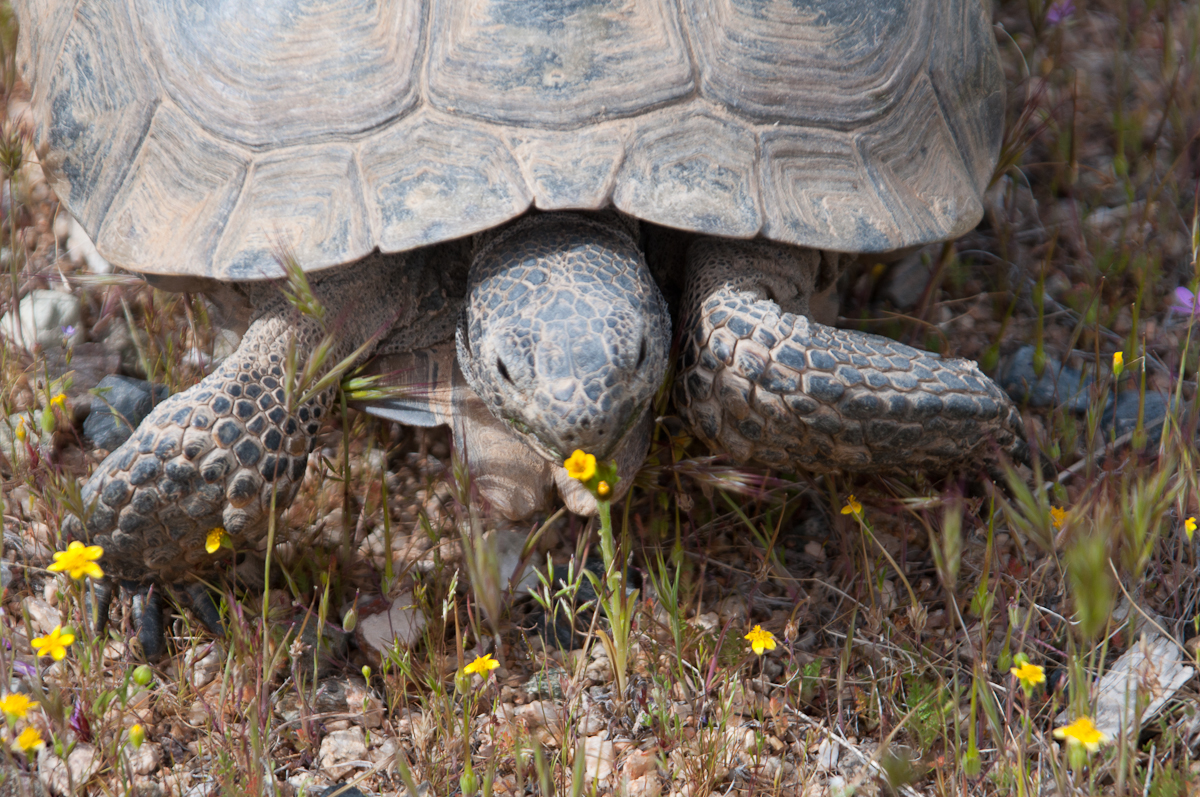
First, there was much more plant and wildflower matter at the DTNA in 2011.  The 2013 docent told me rain had been very scarce the previous winter and so the entire reserve was well dried out.  While in 2013, we see Starfoot nibbling at the sand, in search of anything to eat and any drops of water; in 2011, she had plenty of greenery to chew.
Wildflowers at DTNA in 2011


Desolate Grounds of DTNA in 2013

Second, Starfoot's shell has apparently taken a beating in the rough conditions of the DTNA.  In the 2011 photos, what looks like the number 59 or 55 can be seen as carved/scratched in the second costal scute (individual shell plate) on the right side (in the picture) of Starfoot's carapace (shell dome). 

Starfoot's Shell Number (2011)
That portion of the shell seem to have been damaged.  Weathering on the dome plates is obvious in the later pics.
Starfoot's Shell Number (2013)
***
I hope to see Starfoot again in spring of 2014.


Differences Between the Leeward and Windward Slopes of the Sonora Pass (CA108)

by Steve Reiss (Dalmdad Landscape Photography - www.dalmdad.com and https://www.facebook.com/Dalmdad.)

October 4, 2013:  A trip over the Sonora Pass, in the California Sierras, gives the average person a good experience viewing the distinction between the windward and leeward sides of the Sierra range.

The windward side (western side) is well wooded up to the Pass altitude.  Snow will block the Sonora Pass for winter, generally between November and May, due to snow accumulation.  Most of the snow will get dropped on the windward (west side) of the Sierras, providing plenty of water to support the dense Stanislaus National Forest.

Looking west at the forested, western, windward side of the Sonora Pass

Then, you reach and cross the Pass and instead of looking towards the pass, you are now looking down the pass.

Looking west (towards windward side)
***
The leeward side of the Pass is in the rain and snow shadow of the Sierras.  Therefore, there is less water to support forest growth.
Looking east at the bare-mountain, leeward side of the Sierra Range.  Very different appearance from the wooded, windward side.


                                                                                     ***

Thursday, October 31, 2013

Halloween Tales in The Nevada and California Deserts

by Steve Reiss (Dalmdad Landscape Photography - www.dalmdad.com and https://www.facebook.com/Dalmdad.)

I am not a big fan of Halloween.  I really lost my taste for Halloween, sometime after I was "egged" while walking home from Eric Brand's place to my own.  However, we at Dalmdad Landscape Photography try to "give the people what they want".  So, here are links to two Halloween stories: 

First, last year we have reported on:The Ghost Bus, The Finger and Phalli on an Arizona Highway.   This story has been repeated by chroniclers of strange Mojave Desert days and ways.  The story is not original to us.  However, next time you are in Laughlin watching the baccarat table and see a player with diabolical red eyes going all in, wonder if the player has the forces of evil on his side.

Second, we have presented a story inspired by deaths or ash spreadings known to occur near the Kwaaymii Overlook. Kwaaymii Mysteries is an entirely fictional tale, inspired by actual events the occur at the Overlook.

We hope you enjoy....
***

Wednesday, October 30, 2013

Scary Halloween-style Creatures

by Steve Reiss (Dalmdad Landscape Photography - www.dalmdad.com and https://www.facebook.com/Dalmdad.)


Scary monsters, super creeps
Keep me running, running scared
Scary monsters, super creeps
Keep me running, running scared

***

BOOOO....Bats are so scary....or at least supposed to be...

What is most scary about bats?


That they hang upside down and have big red eyes?? (Photo taken in public park, Darwin, NWT, Australia)
That they Hide their heads in their wings? (Photo taken in Texas)


Or their big, check that...huge... sets of family jewels? (Photo taken in Texas)
***
How about some scary tarantulas...What is so scary?  Most species of tarantulas are not even dangerous to humans, and some species have become popular in the exotic pet trade.


(photo Angeles National Forest)


(photo near Niland, CA)


***
What about some freaky spiders...eww, so scary.


(photo taken in Australia)


***
 And let us not forget, the evil one...Mr. Tazzzzmanian Devil


(photo taken in Australia)


***
I saw this freaky animal cut-out at the Taipei Zoo.  Never was sure what it actually was.


***
Happy Halloween!!

Tuesday, October 29, 2013

Scary Place! Halloween!

by Steve Reiss (Dalmdad Landscape Photography - www.dalmdad.com and https://www.facebook.com/Dalmdad.)

As part of our Halloween series, I would like to give you the experience of walking through the Catacombs of Paris.  We were lucky enough to visit the Catacombs in 2003.

If you are going to visit the Catacombs, keep in mind that for a long portion of the beginning of the tunnel, there is nothing to see.  After descending a narrow spiral stone stairwell of 19 meters to the darkness and silence broken only by the gurgling of a hidden aqueduct channeling local springs away from the area, and after passing through a long (about 1.5 km) and twisting hallway of mortared stone, thats about all the excitement there was.

I was getting depressed; I was like, "So where are the skulls and bones?"

Well, ask and ye shall receive.  Or, ask and I will show you!


This poorly exposed picture is kind of effective in some kind of way

Hey.  Where is my jaw?  Someone took my jaw!

Just some bodies/buddies?

Kind of gives an alien vibe.


The Latin carved into this cross appears to be a loose translation from The Book of Daniel 12:2:
 "And many of them that sleep in the dust of the earth shall awake, some to everlasting life, and some to shame and everlasting contempt."
***
Some interesting tidbits about the Catacombs:
  • The Catacombs contain the remains of approximately six million Parisians.
  • The first known visitor was France's King Charles X in 1787.
  • The first known public visits only began after the 1814-1815 war.
  • The Catacombs were closed completely from 1833 because of church opposition to exposing 'sacred' human bones to public display.
  • Some of the bone arrangements are almost artistic in nature, such as a heart-shaped outline in one wall formed with skulls embedded in surrounding tibias.
  • The tomb of Philibert Aspairt, lost in the Catacombs in 1793 and found 11 years later, is located in the Catacombs on the spot where his body was found.
  • Because the Catacombs are right under the Paris streets, large foundations cannot be built. For this reason, there are not many tall buildings in this area of Paris.
  • The temperature in the Catacombs is a constant 57F/14C.
  • The perfect acoustics of the Catacombs spurred a 19th-century "underground" concert of Chopin and Beethoven.
 ***

If you would like to visit the Catacombs, its official website is here.